Practice
How to keep a food diary without counting calories
Most food diaries are built around a number, which is why so many people give them up. A diary can do something else entirely: keep a plain record of what you ate, when, and how it felt, so that patterns you can't hold in your head become visible over a few weeks.
A record, not a scorecard
The moment a food diary contains a running total, it stops being a description of your day and becomes a test you're either passing or failing. That's most of the reason food diaries feel awful, and most of the reason they get abandoned early.
A diary without numbers has a different job. It's there to notice things that are genuinely hard to notice from inside a single day: that you almost never eat between noon and eight, that the evenings that end badly are the ones with no real lunch, that a particular meal shows up whenever a particular kind of day does. None of that is visible in the moment. It's only visible across a few weeks of entries.
So the standard for a good entry isn't accuracy. It's honesty and low effort. An entry that says 'toast, standing up, late, still cross about the meeting' is worth more than a precise inventory of a meal you no longer remember eating.
One thing before any of the how-to, because it changes who this page is for. Recording food isn't neutral for everyone. If you have a history of an eating disorder, or if tracking has previously tipped into checking, restricting, or a preoccupation you couldn't put down, then a diary — even one with no numbers in it — may not be the right thing to pick up, and that isn't a personal weakness or a reason to try harder. If a doctor, dietitian, or therapist is looking after you, their guidance comes first, including where it says not to keep a record at all. There's a fuller list of the warning signs near the end, but please read it before you start rather than after.
A scorecard
- A running total to come in under
- Portions weighed, brands looked up
- A verdict at the end of the day
- A missed day reads as failure
A record
- What you ate, in ordinary words
- Roughly when — the gaps matter
- How it felt, in one clause
- A missed day is just a gap
What to write down
Four things cover almost everything worth having, and none of them require measuring.
What you ate, in ordinary words. 'Pasta and whatever was in the fridge' is a fine entry. You don't need portions, brands, or an itemised list — you need enough that reading it back in three weeks brings the meal to mind.
Roughly when. Not to the minute. The gaps between entries turn out to be some of the most useful information in the whole diary, and you only get them if there's a time attached.
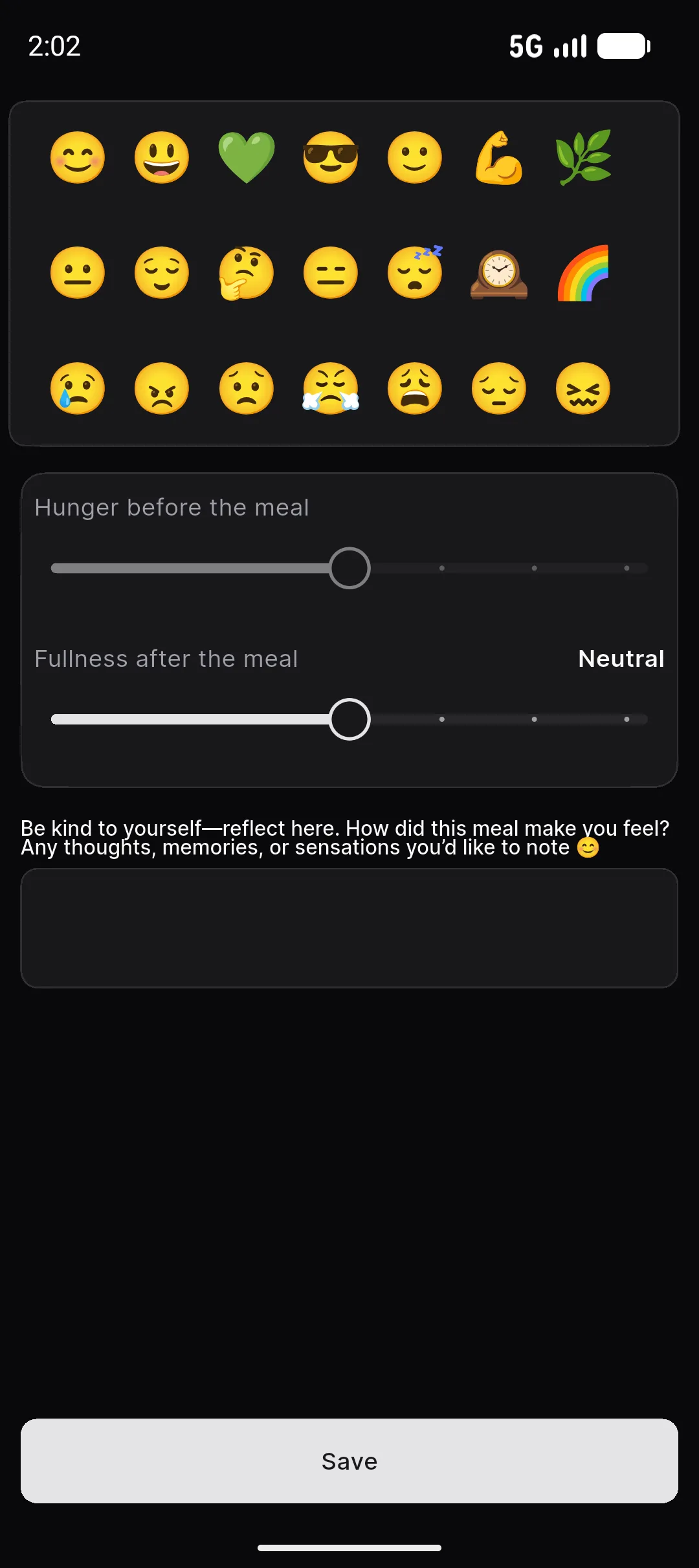
How hungry you were before, in your own words. 'Not really', 'starving', 'couldn't think straight'. If you like a scale, use one loosely — but the words work just as well, and they're harder to turn into a target.
How it felt, or what was going on. One clause is enough. 'Rushed.' 'Actually enjoyed it.' 'Ate it while answering email.' 'Bored.' This is the field that makes the diary worth reading later, and it's the one people leave out first.
Write it after, not during
Logging a meal before or while you eat it changes the meal. You end up watching yourself eat, editing what you choose because it's about to be written down, and turning food into an admin task. A note made a few minutes afterwards keeps the meal intact.
Afterwards also has the advantage of including how it went, which you can't know in advance. Whether you were still hungry, whether it was satisfying, whether you'd stopped thinking about food half an hour later — that's the part with information in it.
If a few minutes afterwards doesn't happen, later the same day is fine. Recall gets thinner as the day goes on, but a rough entry written at bedtime is far better than a perfect one you never wrote.
Photos count
If writing feels like too much friction, take a picture instead. A photo captures the meal in under a second, timestamps itself, and gives you something concrete to look at later — which is a large part of what the diary is for.
There's some evidence that photographing meals shifts what people choose, in the sense that seeing the meal as an image makes you notice it more clearly than eating it does. That effect can cut both ways, so it's worth being honest with yourself about which one is happening: if the camera has started functioning as a supervisor, it's doing the thing this whole approach is trying to avoid.
A hybrid tends to work best in practice. Photo for the meal, one line of text for the part a photo can't hold — how hungry you were, what kind of day it was, whether you were sitting down.
Naming the feeling is the point
The 'how it felt' line does more than record data. Putting an experience into words is itself a way of settling it — naming what you're feeling reliably turns the volume down on it, which is why 'I'm anxious and I want something crunchy' lands differently than the unnamed version of the same state.
This matters most for the eating that happens when you're not especially hungry. Written down as 'crisps, 4pm, flat and bored after that call', an episode becomes a thing that happened for a reason. Left unnamed, it tends to become evidence about your character, which is both less accurate and much less useful.
You don't need emotional vocabulary for this. 'Tired', 'wired', 'fine', 'weird day' are all real entries. The act of naming is doing the work, not the sophistication of the name.
The days you miss
You will miss days. Everyone does, and the missed days are not a failure of the project — they're a normal feature of it. A diary with holes in it still shows you patterns; a diary you abandoned because of the holes shows you nothing.
Resist the urge to reconstruct. Backfilling three days from memory produces a tidy record of a week that didn't happen. Leave the gap, start again at the next meal, and let the record be uneven.
It's also worth noticing which days go unrecorded. The meals people skip logging are very often the ones they'd rather not look at — and that pattern, once you spot it gently, is usually more interesting than anything in the entries themselves.
Reading it back
Give it two or three weeks before you read anything as a pattern. Any single day can be explained by a single day; it takes a stretch of them before something real shows up.
When you do read back, look at the shape rather than the contents. Where are the long gaps? What time of day do the difficult entries cluster? What was true about the days that felt easy — did you eat earlier, sit down, sleep well, have less on? The useful finding is almost always about circumstances rather than about food.
One rule for reading: no verdicts. You're looking for 'evenings are hard when lunch was a coffee', not 'I have no discipline after 6pm'. The first one suggests something to change. The second one just hurts, and it's the reason most people can't bear to reread their own diary.
It helps to read your own notes the way you'd read a friend's. Treating yourself with the same ordinary kindness you'd extend to someone else isn't a nicety here — it's a skill, and it's the difference between a record you keep using and one you quietly delete.
Words worth leaving out
Some words carry diet culture into the diary no matter what else you do. 'Good' and 'bad' are the main two. 'Cheat', 'earned', 'allowed', 'behaved', 'ruined it' are close behind. They read as descriptions and function as scoring.
The substitution is easy: write what happened. 'Two slices of cake at the office thing' instead of 'terrible day, gave in again'. The first is a fact and might turn out to be part of a pattern. The second is a sentence about your worth, and it will make you avoid the diary within a fortnight.
The same goes for weight, measurements, and step counts. A diary that mixes them in stops being a record of your eating and becomes a comparison against a target, which pulls it straight back into the thing you were trying to leave.
How long to keep it up
Two to four weeks is enough to see most of what's there. After that, a diary kept indefinitely tends to shade into monitoring, and monitoring has diminishing returns — the noticing becomes automatic, and the writing becomes an obligation.
A reasonable pattern is to keep one for a few weeks, stop, and pick it back up when something changes: a new job, a stretch of hard days, a period where eating has started to feel confusing again. It's a diagnostic tool you take out when you need it, not a habit you owe something to.
If keeping it starts to feel like an obligation rather than a curiosity, that's a signal to stop rather than to try harder. Nothing in this is worth doing joylessly.
When a food diary isn't the right tool
As said at the start, recording food isn't neutral for everyone, and a diary with no numbers in it is still a diary. What's worth having in advance is a sense of what it looks like when one starts going that way.
The signs are worth knowing in advance: feeling anxious when you can't log something, editing what you eat because of how it'll read, rereading entries repeatedly, or finding that the diary has become the main thing you think about at meals. If any of that starts happening, stopping is the right move, and it's worth mentioning to a doctor or therapist.
For structured work on eating patterns — particularly if eating feels out of control at times — the versions that have actually been studied are done with a clinician rather than alone. Mindfulness-based approaches to binge eating have evidence behind them, and they're delivered as programmes with support, not as a notebook and good intentions.
The short version
Write what you ate, roughly when, how hungry you were, and how it felt. Do it a few minutes afterwards. Use photos when writing is too much. Leave the gaps where they fall.
Read it back after a couple of weeks, looking for circumstances rather than faults. Then put it down. A food diary is a way of getting to know your own days, and once you know them, you don't need the notebook.
What the research says
-
Lieberman M.D. et al. (2007)
Putting a feeling into words reduces activity in the brain's threat response — which is part of why writing down how a meal felt tends to settle the experience rather than amplify it.
-
Doumit R. et al. (2016)
Recording meals with phone photographs changed what people went on to choose, suggesting a visual record makes eating easier to notice than memory alone does.
-
Robinson E. et al. (2014)
A systematic review and meta-analysis found that attention to eating and memory of what was eaten influence how much people eat afterwards — a meal you barely registered is both harder to write down and less likely to settle.
-
Neff K.D. & Germer C.K. (2013)
Self-compassion can be practised and taught, and doing so improves wellbeing — relevant to how you read your own entries back.
-
Kristeller & Wolever (2011)
Structured mindfulness-based approaches to binge eating are delivered as supported programmes rather than self-monitoring alone.
Frequently asked
What should I write in a food diary if I'm not counting calories?
Four things: what you ate in ordinary words, roughly when, how hungry you were beforehand, and one clause about how it felt or what was happening. No portions, no measuring, no totals. The last field is the one that makes the diary worth reading later, and it's the one most people skip.
Does a food diary work without tracking numbers?
It works differently. A counting diary answers 'how much', which most people already have a rough sense of. A non-counting diary answers 'when, and in what circumstances' — the timing of meals, the length of the gaps, what the hard days have in common. Those are the questions you can't answer from inside a single day.
How long should I keep a food diary?
Two to four weeks is usually enough to see the patterns that are there. Beyond that it tends to shade into monitoring, where the effort keeps going up and the new information stops. Stopping and picking it up again later, when something changes, works better than keeping one forever.
What if I forget to log meals?
Leave the gap and carry on. Reconstructing days from memory produces a tidy record of a week that didn't happen. A diary with holes still shows you patterns — and noticing which meals tend to go unlogged is often more informative than the entries themselves.
Can keeping a food diary be harmful?
It isn't the right tool for everyone. If you have a history of an eating disorder, or tracking has previously tipped into checking and restricting, a diary with no numbers in it is still a diary, and whether to keep one is a decision to make with whoever is looking after you rather than alone. Warning signs include anxiety when you can't log something, changing what you eat because of how it'll read, and rereading entries repeatedly. If that's happening, stop, and mention it to a doctor or therapist.
Should I write down how I felt as well as what I ate?
Yes — it's the most useful field in the diary. Naming a feeling tends to settle it, and an entry like 'crisps, 4pm, flat after that call' turns an episode into something with a reason attached. Without it, the same episode tends to get filed as evidence about your character instead.
Try How It Felt
A calmer way to be with food.
Free, no account, all data on your device.