


01
Emotion-first
Hunger, fullness, and twenty-one feelings. Notice what's actually happening — not what a number says about you.
A mindful eating journal
No calories. No tracking. No judgement.
A private space to pause and notice how you feel around meals. Just a moment for yourself.
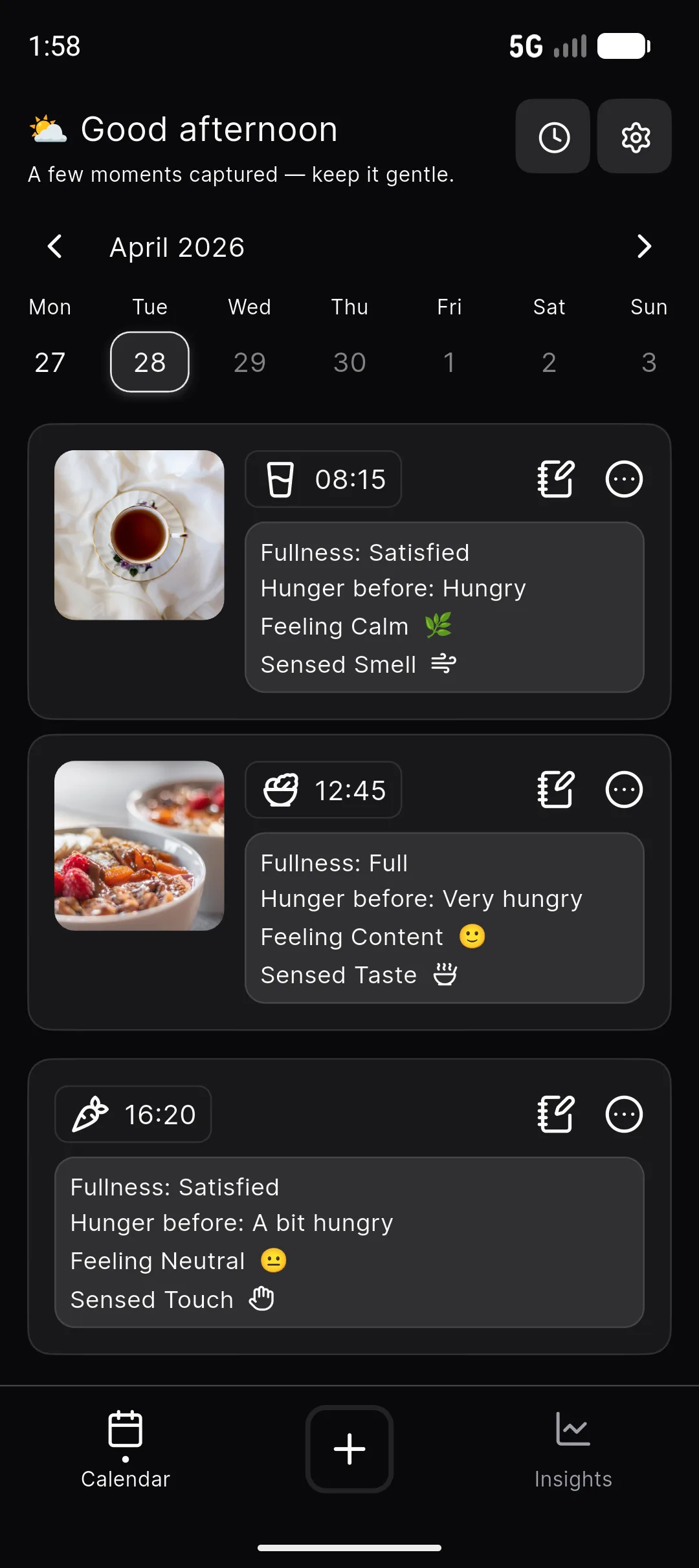
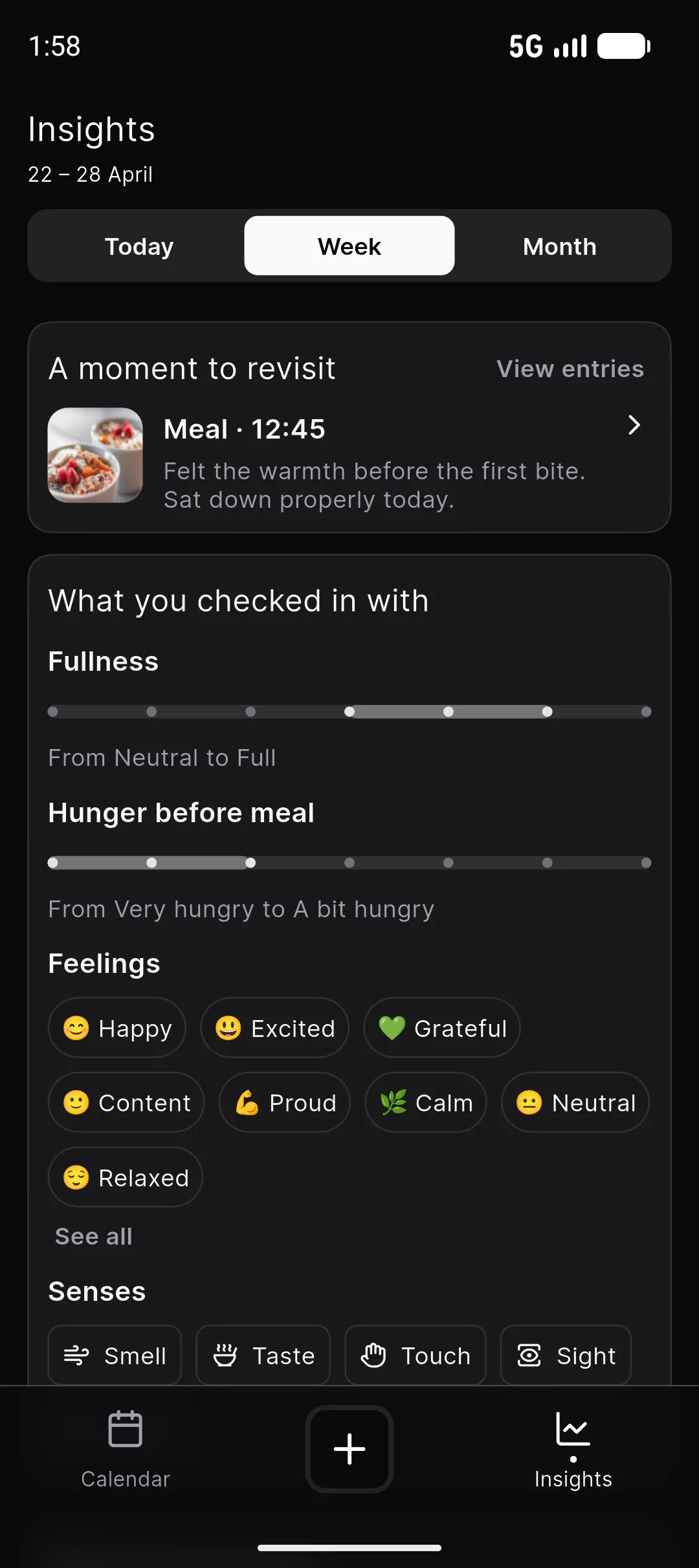
Live preview Calendar
The promise
01
Hunger, fullness, and twenty-one feelings. Notice what's actually happening — not what a number says about you.
02
Everything stays on your device. No accounts. No cloud. No analytics on your entries. Only you can ever see them.
03
No calories, no streaks, no scores, no rankings. Just space to be honest with yourself, on whatever day this is.
Features
Mindful eating timer
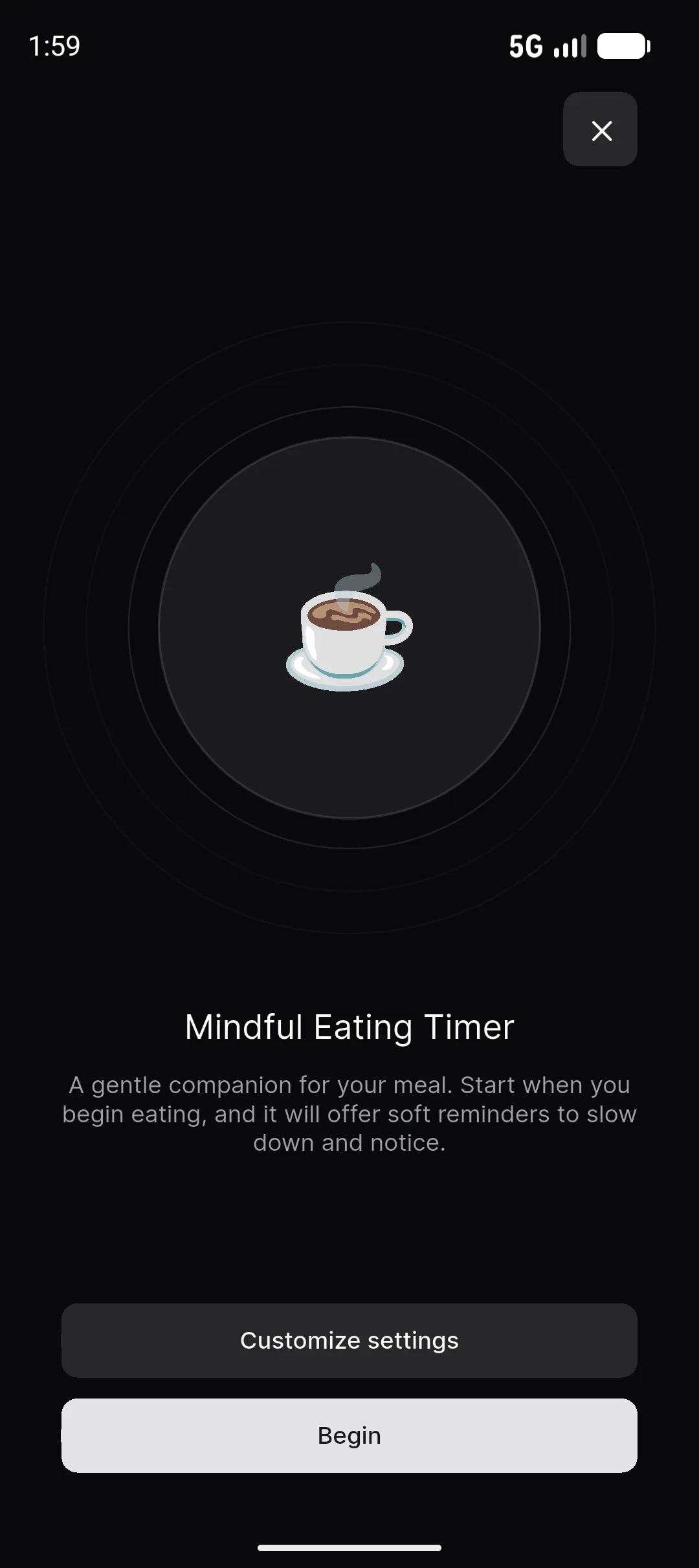
Start when you begin eating. The breathing circle keeps time, and soft prompts arrive every few minutes. Four ambient soundscapes if you'd like one.
Camera-first journaling
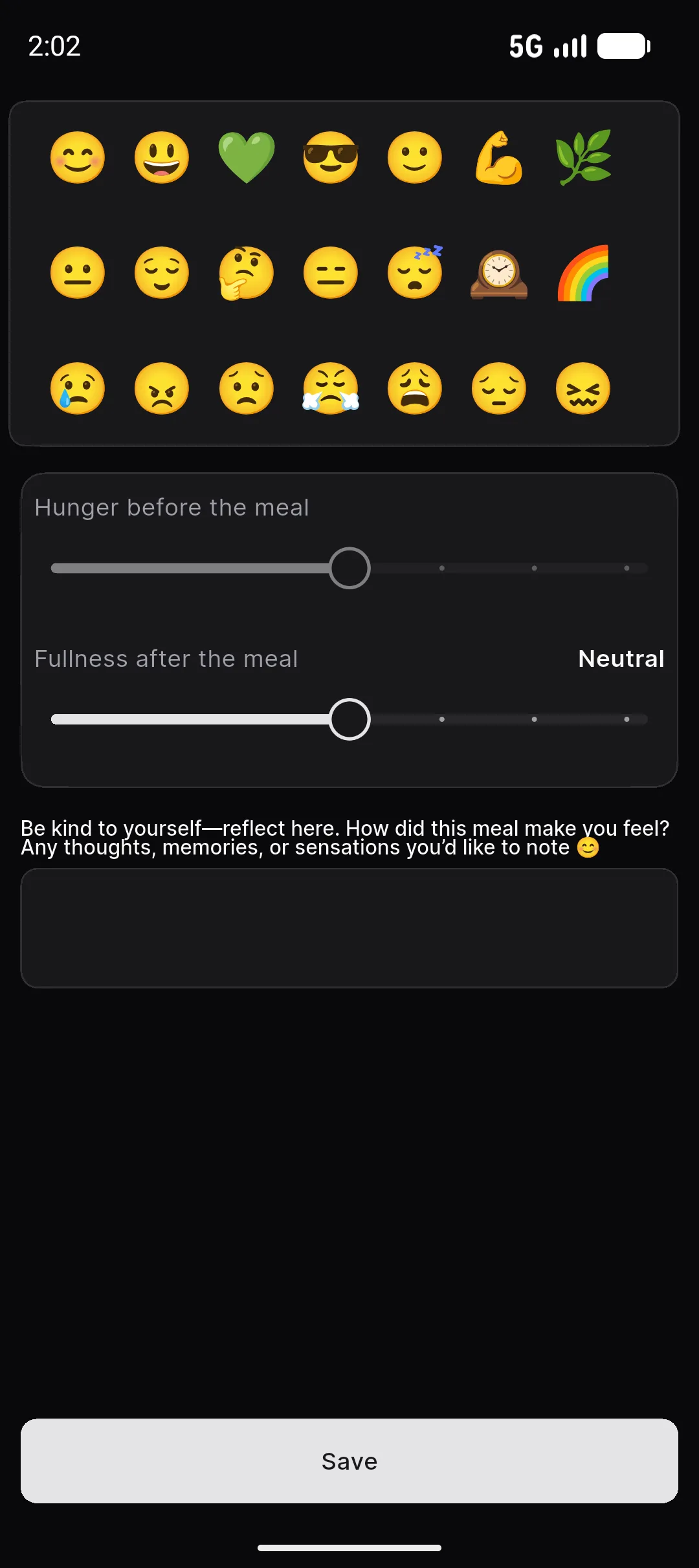
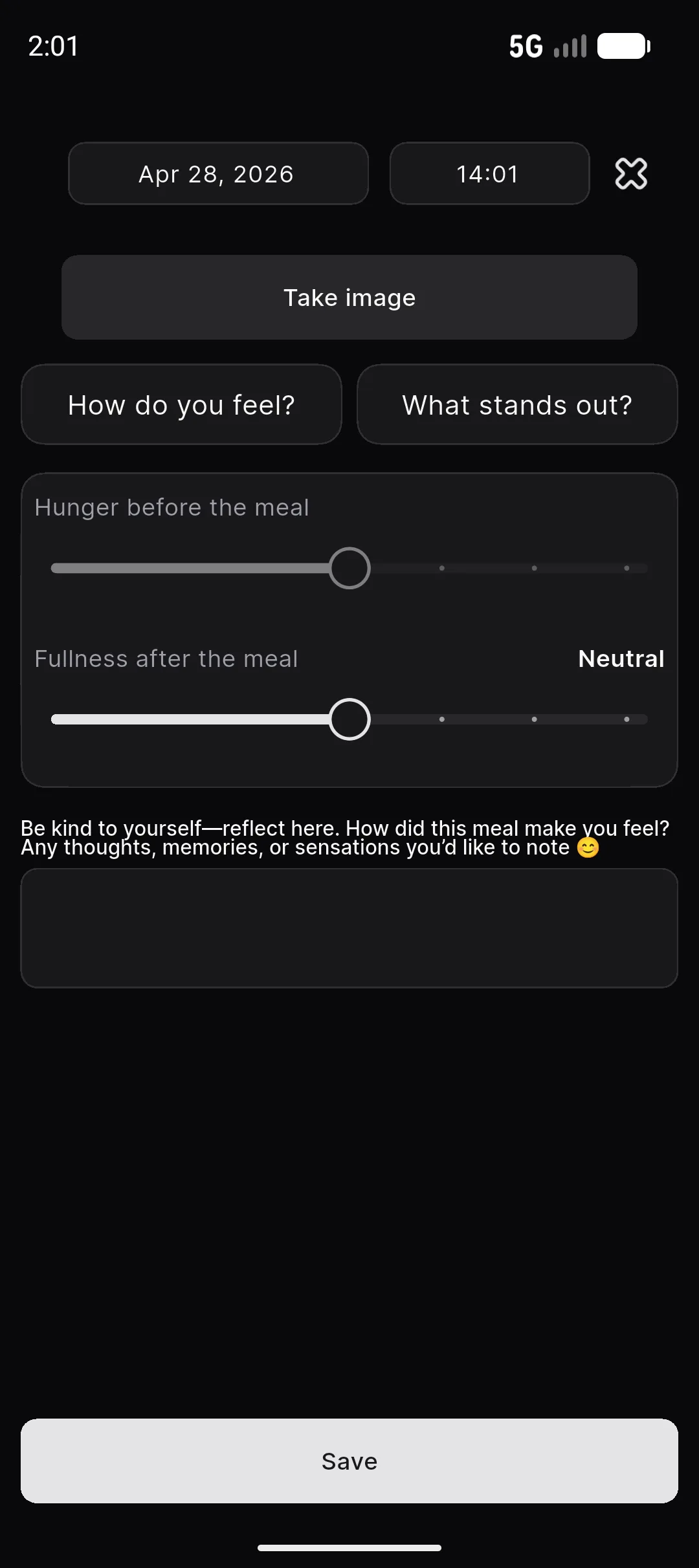
Snap a photo or skip it. Note hunger before, fullness after, one feeling, one sense, and anything you want to remember. Five seconds is enough.
Calendar + Insights
A simple calendar of moments and a quiet insights view: what you checked in with, photos from this time, gentle prompts for next time.
Affirmations
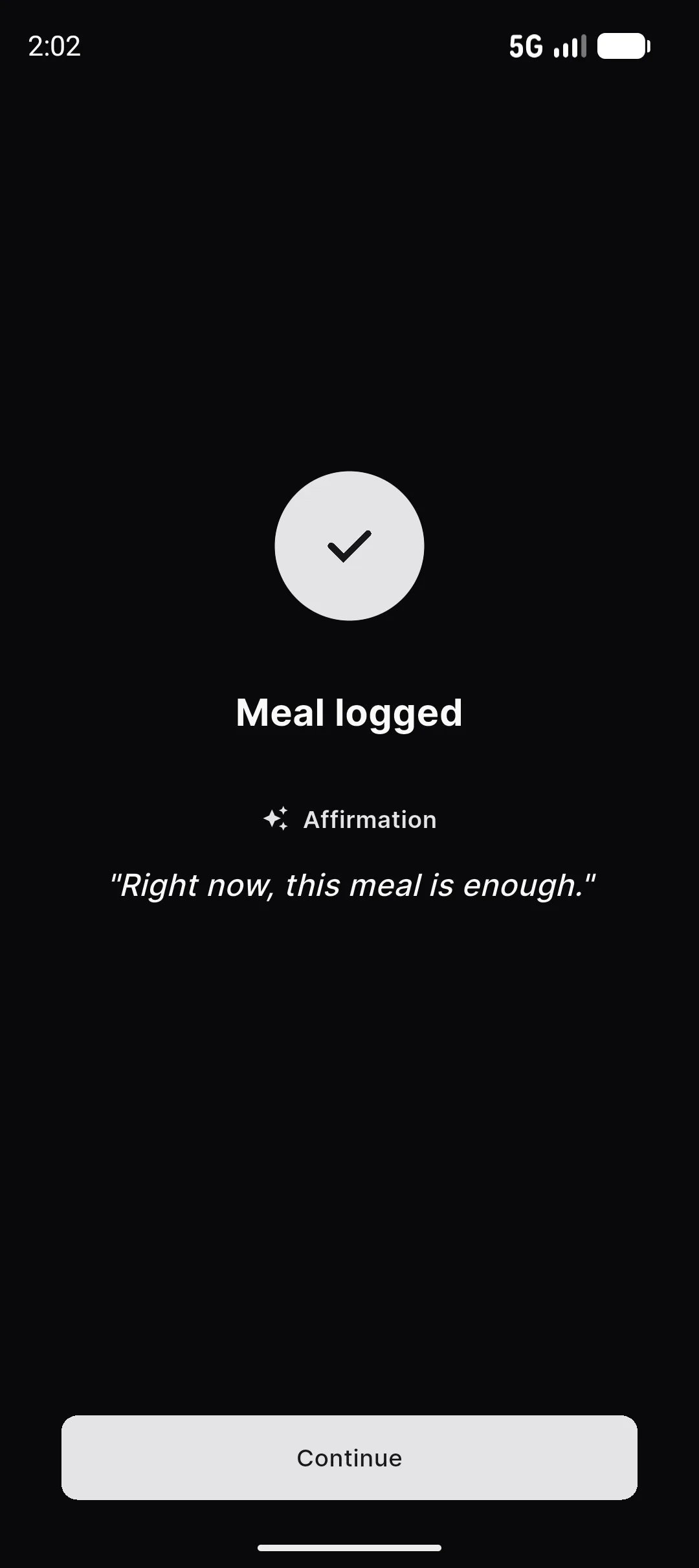
Choose to receive a short, supportive message after logging. Or turn affirmations off completely — your reflection, your way.
Twenty-one feelings · Three families
After each meal, choose a feeling that fits. There's no right answer — just an invitation to notice. Hover to slow the ribbon.
Built around the research
Every choice in this app is anchored in published research on mindful eating, emotion regulation, and self-compassion. The footnotes link to full citations.
Fullness signals exist — they just need about 30 minutes to arrive. Slowing down lets you notice them.2
Kokkinos et al., 2010 · Peer-reviewed
Brief emotional check-ins — even just a word — reduced mealtime stress in about six weeks.3
Kristeller & Wolever, 2011 · Peer-reviewed
Across 24 studies, eating without distractions left people more satisfied and more at ease.4
Robinson et al., 2014 · Peer-reviewed
More from the literature
People who eat slowly consume about 88 fewer kcal per meal — without trying to eat less.5
Andrade et al., 2008
Mindful eating interventions cut binge frequency roughly in half across published trials.6
Katterman et al., 2014
Distracted eating dampens fullness signals and increases what people eat later in the day.7
Robinson et al., 2013
Naming an emotion reduces amygdala activity — putting feelings into words calms the body.8
Lieberman et al., 2007
Self-compassion is more strongly linked to long-term wellbeing than self-criticism or self-esteem.9
Neff & Germer, 2013
Photographing meals for awareness (not calorie counting) supports more intuitive eating patterns.10
Doumit et al., 2016
Who this is for
You don't need to fix yourself. You just need a quieter way to listen.
How It Felt is for people who want a quieter way to notice meals. It doesn't score you, count you, or coach you. It just gives you space to check in — and gently get to know yourself again.
Pricing
The journal stays free, including 7-day exports. Becoming a Supporter helps us keep it ad-free, account-free, and quiet — for everyone.
$0
Forever. No account, no card.
7 days free
Help us keep it ad-free, account-free, and quiet. Cancel anytime.
Questions
Still wondering? Email howitfeltapp@gmail.com
No. There are no calories, macros, weight tracking, or scores. The diary captures hunger, fullness, feelings, senses, and a photo or note — and that's it.
Everything stays on your device, in a local database (Drift / SQLite). There are no accounts, no cloud sync, and no analytics on your entries. You can export your data as CSV or PDF at any time.
Only if you want them. After each entry you can see a short, supportive message — and you can turn affirmations off completely in settings.
No. How It Felt is for self-reflection and journaling. It doesn't provide medical or therapeutic advice. If you're working through something hard, please reach out to someone qualified to support you.
English, German, Spanish, French, Italian, and Portuguese. The app picks up your phone's language automatically; you can also change it in settings.
iOS and Android phones. The app is mobile-only — there's no web or desktop version, and no plans for one right now.
Footnotes
Every claim and statistic on this page is footnoted. Click any superscript above to land here.
Local-only data: How It Felt stores all entries on-device using Drift / SQLite. No cloud, no accounts. See FAQ for details.
Kokkinos A. et al. (2010). Eating slowly increases the postprandial response of the anorexigenic gut hormones. The Journal of Clinical Endocrinology & Metabolism, 95(1), 333–337. DOI
Kristeller J. & Wolever R. (2011). Mindfulness-Based Eating Awareness Training for Treating Binge Eating Disorder. Eating Disorders, 19(1), 49–61. DOI
Robinson E. et al. (2014). Eating attentively: a systematic review and meta-analysis of the effect of food intake memory and awareness on eating. The American Journal of Clinical Nutrition, 97(4), 728–742. DOI
Andrade A.M., Greene G.W., Melanson K.J. (2008). Eating slowly led to decreases in energy intake within meals in healthy women. Journal of the American Dietetic Association, 108(7), 1186–1191. DOI
Katterman S.N. et al. (2014). Mindfulness meditation as an intervention for binge eating, emotional eating, and weight loss: A systematic review. Eating Behaviors, 15(2), 197–204. DOI
Robinson E. et al. (2013). Distracted eating and recall of recent eating: A laboratory experiment. Appetite, 60, 197–201.
Lieberman M.D. et al. (2007). Putting Feelings into Words: Affect Labeling Disrupts Amygdala Activity in Response to Affective Stimuli. Psychological Science, 18(5), 421–428. DOI
Neff K.D. & Germer C.K. (2013). A Pilot Study and Randomized Controlled Trial of the Mindful Self-Compassion Program. Journal of Clinical Psychology, 69(1), 28–44. DOI
Doumit R. et al. (2016). Effects of Recording Food Intake Using Cell Phone Camera Pictures on Energy Intake and Food Choice. Worldviews on Evidence-Based Nursing, 13(3), 216–223. DOI